I would like to disclose that I am by no means a professional at fly fishing for coho salmon or any fish for that matter. This past fall was my first time fly fishing for Lake Superior run salmon and steelhead. I wanted to give a beginners guide by a beginner. Not because I feel that I have a clue of what I am doing (because I don’t) but because I did not have a clue of what I was doing. It was just a lent 8 wt fly rod, a Lake Superior tributary, and myself trying to land a famous coho.
With that disclaimer being said, I did learn a lot from the several times that I went out to the river with some hope and a dream. I will not be name dropping the river but I will say that it flows into Lake Superior; so if you were waiting for that I still encourage you to keep reading and maybe learn something.
Starting off with the 8 wt rod I was lent for the season. Being on a student budget, a new or even to me rod and reel was out of the question. Treating myself to Culver’s after fishing hard meant sacrificing a full tank of gas. Anyways, I was lent a rod from my boss and fishing mentor. He is also on the board of the local Trout Unlimited chapter. His only request is that in the future, if there was a college kid that needed a rod I must lend him one. Of course, it’s a deal. I did not know the brand of the rod or reel, I just knew that it was an 8 wt and I was going to catch a big fish with it.
It did take some time getting used to the casting. It was longer than any rod I had used before and it felt that it was more springy and flicky with the flies. After some practice casts and wading across the river more times than I’d like to admit to retrieve my fly from a branch on the other side, I felt semi-confident. Time to actually go fishing.
I did not look up or watch any videos on what these fish liked to eat. From books that I read in the past, angler’s also didn’t know. It was a guessing game with water temp, flow rate, cloudiness, and if you brushed your teeth in the morning. I was given the tip of using a bead to replicate an egg, but I lost the only bead I had while practicing casting. Since I knew these fish were very aggressive when they spawn (like all fish), I wanted to replicate a smaller fish maybe trying to eat the spawn. I tied on a cream and burgundy beaded Wolly Bugger that I had tied a few days prior. I tied a few of them knowing that I would lose some. After about an hour of fishing I lost them all.
Time for plan B, my favorite fly to fish and tie. It was the fly that when the skunk was walking along side me, it was basically a guarantee to catch a fish (knock on wood) and scare the skunk away; the mop fly. The mop fly is an easy fly to tie and an easy fly to fish. I fish it like a small streamer and just slowly strip it back to me. Unfortunately, that day I must not have brushed my teeth because the skunk followed me around all the way until I was back to the car.
The next outing I had more luck. Still no fish but that time I had at least seen one. The biggest fish I had ever seen in that river. It’s dark green and speckled back swaying back and forth in the current. It was nearly fully camouflaged with the river bottom. I had a pink and black mop fly tied on so I tossed it a little in front of it. It spooked and darted back a few feet and kept swimming in place. I tossed the fly a few feet in front and let the current drag the fly down to only an inch in front of the fish’s mouth, but still no bite. I tried a few more times but eventually the fish got spooked and swam off. Later on, I spotted another one, this one bigger than the last, swaying in one spot along the bank barely visible behind the tall grass. I took one too many steps and in the blink of an eye it was no longer there.
I was starting to recognize a pattern with these fish. They liked swimming stationary along the bank where they are hidden by the long grass. The faster current pushes food right too them and any bugs or small rodents that fall off from the bank land right on top of them. I started walking with more stealth, keeping my eyes peeled for anything that remotely resembled a fish. After a few more days of fishing, I spooked several fish, all from moving too fast and not looking ahead. I did however hook into one, but when I went to retrieve my net, I slipped down the hill and almost into the water. With the line slack, the barbless hook slipped out of the mouth and there was a slew of words that I’m sure the trees have heard for many years.
After losing the biggest fish I’ve ever had on fly line, I was even more encouraged to finally land one. With the days getting colder and more carcasses floating along the bottom of the river, I knew my time was coming to an end to land one. The stars aligned one day and the conditions were perfect. I cleared my schedule and headed to the river. This time I wanted to walk upstream, it was new territory but I wanted a change in scenery. Not 50 yards from where I normally started there was a small pool that held two coho. They were not the biggest I had seen but I wasn’t out there to catch a trophy, I was there to catch my first.
With the trusty pink and black mop still on my line, I worked that pool for 15 minutes. The fish stayed put, swimming into the current and hiding under the bank. I decided to let them rest so I walked upstream. After 20 minutes or so, I walked back to the pool to see if they were still there; fortunately, they were. After five minutes of tossing and flipping, one bit. I held the line tight and stripped the line in, holding it just to get my net from my hip. The fish was so big it wouldn’t fit in the net! After trying to wrangle the monstrosity it eventually came loose. Not wanting it to escape I hugged the fish against my chest and placed it on the grassy shore.
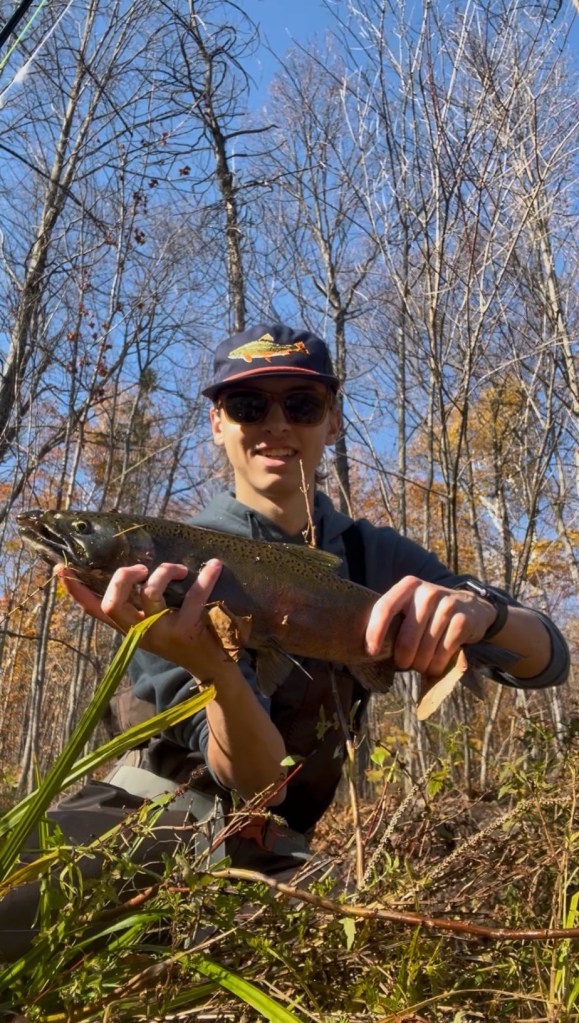
After many, many hour and spooked fish, I finally landed a coho salmon. I quickly took my picture and released it back into the river. After facetiming my girlfriend and wiping the fish slime from my phone, I couldn’t keep a smile off my face. The sun was still lighting the sky so there was still more time to fish. I walked downstream to the normal spots I hit. I used all that I learned and blindly cast the mop over some tall grass and let it float down. I had spooked a fish here a few days prior and like a dog to a tree that had a squirrel in it one time years ago, I always cast there just in cast. This time I was rewarded with my line going tight and the fish jetting to faster current. It it being a few feet in front of me, I jumped to a new position on shore and quickly net it.
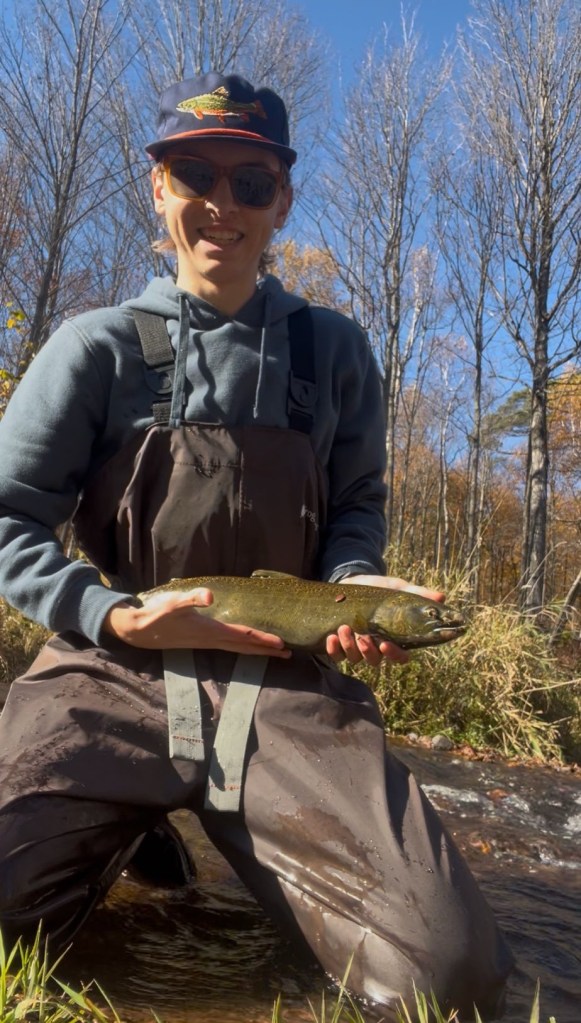
This fish was smaller than my first and looked more zombie like, as it was nearing the end of its life. I took a quick picture and released it into deeper water where it swam off to recover. Two fish in one day was more than I hoped for. Not wanting to use all my luck in one day, I head back to my dorm to eat dinner. It was a good day of fishing.
To recap everything that I learned into a quick paragraph: salmon like to sway near the bank where they are hidden by the long grass, you need to brush your teeth before you go out, the mop fly is the greatest fly of all time, keep the line tight, and the more time you spend on the water the more likely you are to catch a fish. I wish you luck if you go out for these fish. The fight is worth spooking ten fish in a row and landing one is worth skipping a class (or work).
I hope this guide had some value and it’s not the blind leading the blind. If you do catch a fish, DM me on Instagram at @flyfluencemedia!
 flyfluence.com
Leave a comment